
















Your Fridge May Soon Know Your Food Is Spoiled Before You Do

Humans rely on sight and smell to decide whether food has gone bad, but spoilage often begins long before either sense notices a problem.
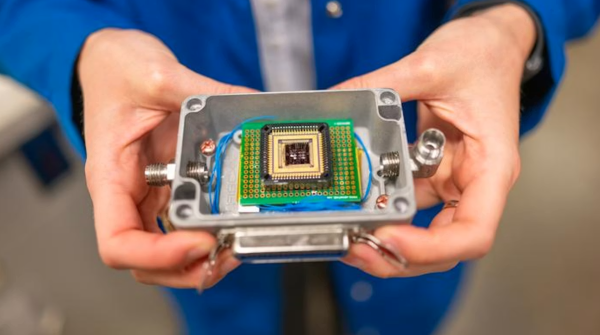
Researchers at the University of California, Berkeley think they have a solution: an electronic nose that can detect food spoilage more accurately than humans. The team detailed the technology in a new study published in Science Advances.
The electronic nose uses 16 miniature gas sensors that react to different airborne compounds. Carla Bassil, a Ph.D. student in electrical engineering and computer sciences at UC Berkeley and the study’s lead author, compared the sensors to “digital taste buds.” They convert chemical reactions into electrical signals, allowing machine learning to identify a food’s unique gas fingerprint.
According to the World Health Organization, unsafe food sickens an estimated 866 million people every year, making early spoilage detection an ongoing food safety challenge.
In an interview with University of California, Bassil said, “I think ‘smart’ fridges—which come with sensors that you can control on your phone—would be a great application for this kind of technology.”
“I think ‘smart’ fridges—which come with sensors that you can control on your phone—would be a great application for this kind of technology,” Bassil said. “How great would it be if your fridge could tell you, ‘Hey, your broccoli’s going to go bad soon, so you should probably eat that’? Or, ‘Your chicken is on its last day’?”
The researchers trained the electronic nose to recognize foods including strawberries, blueberries, bananas, walnuts, hazelnuts, cashews, peanuts, raw chicken, milk, and eggs. They also taught it to distinguish between fresh eggs and eggs left at room temperature for 24 and 48 hours.
One surprising finding showed just how sensitive the human nose already is. Researchers found people could detect as little as 0.05 grams of isolated walnut—roughly one hundredth of an average shelled walnut.
For now, the team has only tested the electronic nose on individual ingredients. More complex dishes, such as salads containing multiple ingredients, will require additional testing before the technology can move closer to real-world use.
“The idea is that we can use the relative selectivity of the gas sensors, paired with the pattern recognition abilities of machine learning, to sort out which gas fingerprint is associated with each food,” Bassil said. “The result is a sensor chip that is far more sensitive and far more objective than any human nose can be.”
In the video below, Bassil explains how the electronic nose works in detail: