














This Modular System Claims To Be Able To Feed Astronauts On Mars For Up To Two Years
While the world still recovers from the pandemic, efforts to explore what life might be beyond our blue planet continues. Of the countless potentially habitable places that populate our solar system, two sit at the top of the list: Mars and our moon. NASA aims to touch down on Mars in the 2030s, while Elon’s SpaceX plans to beat them to the punch. Each year we inch closer and closer to life in space.
That said, according to CNN, landing on either of these orbital bodies is only a small part of the challenge. The other, possibly bigger challenge, is making sure astronauts can survive long enough to make it habitable. Take Mars for example; its atmosphere is 100 times thinner than our own, it only receives half the sunlight, has no known fresh water, and experiences average temperatures of -81 degrees Fahrenheit. Basically, a dead human’s land.

Paris and Los Angeles-based startup Interstellar Lab hopes to make Mars living a reality with their controlled-environment crop-growing capsule system. “Interstellar Lab is the pursuit of a child’s dream in the context of the climate crisis on Earth. At the youngest age, I dreamt of becoming a multi-planet species and to live under domes on other planets, surrounded by plants.” says CEO Barbara Belvisi.
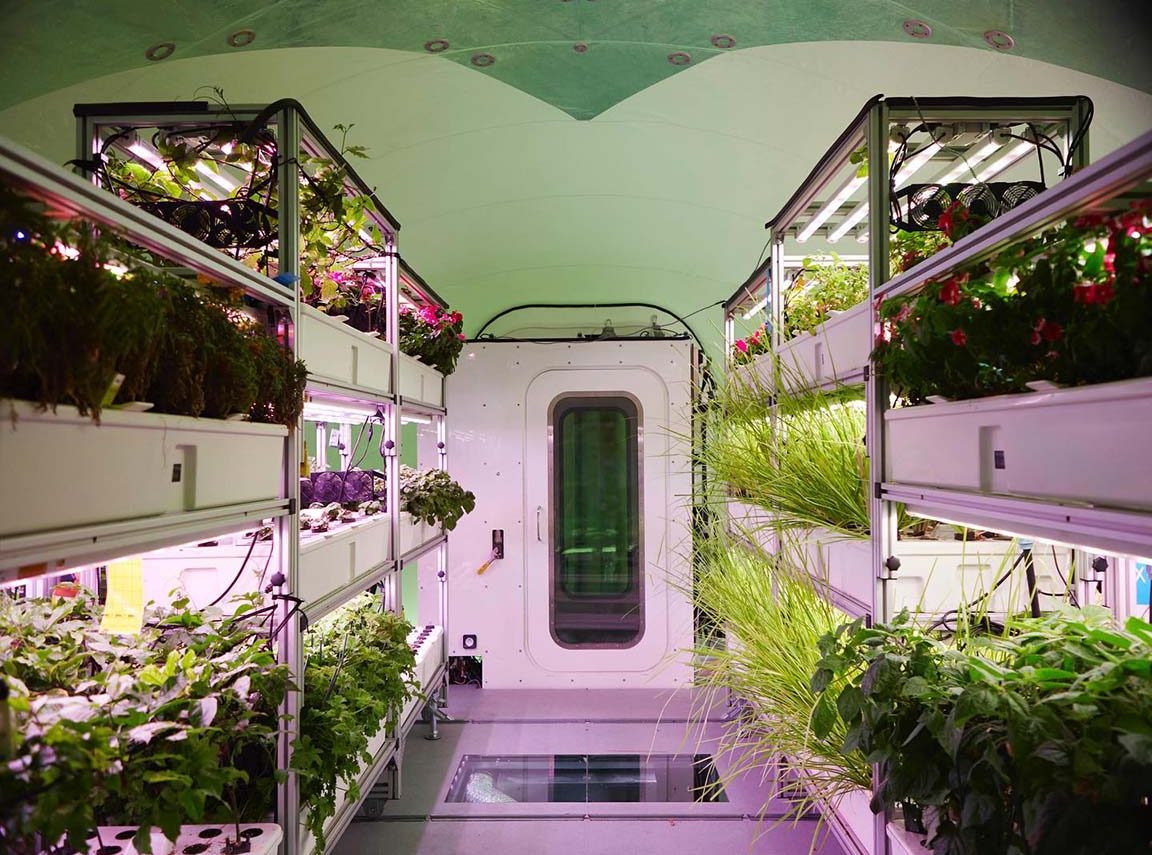
Launched in 2018 following a year working with engineers at NASA AMES Space Portal, Belvisi believes Interstellar Lab’s Nutritional Closed-Loop Eco-Unit System, also known as “NUCLEUS,” is the answer. It’s a modular system that consists of nine nutrition cube capsules which can feed up to four astronauts on a two-year mission. It grows fresh microgreens, vegetables, mushrooms, and also edible insects.

“The initial focus was to build a regenerative food production system to advance sustainable farming on Earth. But I asked, ‘what if the technology we will need to live in space could help us live more sustainably on Earth?’ That’s how the concept of advanced controlled-environment modules for Earth and space was born,” Belvisi shares.
So far, NUCLEUS is one of the winners from Phase 1 of NASA’s Deep Space Food Challenge and one of the 11 Phase 2 finalists. It works by using vertical farming, which allows food to be grown without soil. Water is nutrient-dense and continuously recirculated to reduce waste.

Evan Fraser, director of Arrell Food Institute at the University of Guelph, wrote the book “Dinner On Mars: The Technologies That Will Feed the Red Planet and Transform Agriculture on Earth,” along with Lenore Newman, director of Food and Agriculture Institute at the University of the Fraser Valley. Fraser believes closed-loop technology could greatly benefit our farming practices here on Earth.
“The vertical farming industry have done a remarkable job of reducing labor, water, and costs such as land costs. They are achieving a huge amount of productivity per square acre, per hour of worker and per liter of water use,” Fraser adds. Not only does Fraser believe vertical farming is a good approach to sustaining life on Mars, he and Newman both say, “It’s the only option.”