









Why Pairing Seafood & Sake Is A Sensory Gamechanger
For most of human history, we had no way of identifying what made certain dishes so delicious. We could describe sour, sweet, bitter, and salty sensations, but not savory. That is, until 1908, when Kikunae Ikeda discovered the fifth taste — umami. Umami is the essence of savory, giving life to some of the world’s most delectable ingredients like meat, soy sauce, and fish paste.
That same year, Ikeda identified the molecular happenings that take our taste buds on this journey. In short, he found that an amino acid called glutamate is largely responsible. Scientists have since expanded on Ikeda’s findings, saying there are nucleotides found in many foods that, when combined with amino acids, intensify the umami experience. It’s this interaction that gives alcohol and meat pairings so much depth, as the amino acids in alcohol pair exceptionally well with the nucleotides found in all meat.
This is especially true in the case of sake, which holds significantly more amino acids than most beers or wine, making it one of the purest tastes of umami that we have on Earth. Because of this, it outshines other alcohols in being paired with umami rich dishes, such as seafood, where most would think to drink something like a glass of white wine.
Sometimes, though, it’s best to drop the fancy talk and put things in layman’s terms. In Foodbeast’s new video regarding the drink, sake expert Chris Johnson says it best. Sake and seafood work, on a basic level, because “the seafood elevates the sake, the sake elevates the seafood, and you have a party.”
The video acts as a crash course in sake, as Foodbeast correspondent George Laboda travels to Rappahannock Oyster Bar in Los Angeles, CA to try nine different seafood and sake pairings. But first, he gets hit with the basics.
There are three overarching types of sake: Junmai, Ginjo, and Daiginjo, each carrying a different percentage of milling, a process that consists of polishing down the rice used to brew sake. The more it’s milled, the more the grain turns into a pure starch, producing a layered, textured brew. This does not, however, mean that as the milling percentage goes up, so does the quality. On the contrary, milling says quite little about quality, and more about the flavor of the sake and what food it might work well with.
The video works to show this by presenting nine different pairings by highlighting a variety of sake along the way — from a hazy, unfiltered desert sake to an unusually amber tinted sake — and their wide-ranging effects on our palate. Check out all the pairings below:
Course #1: Raw Oysters & Konishi Aosae no Sumikiri Junmai

Old Salt oysters topped with a kimchi vignette met a sharp Junmai that relaxed the brininess of the raw oysters.
Course #2: Grilled Oysters & Nanbu Bijin Shinpaku Junmai Daiginjo

The next course showed the textural application of sake by pairing a grilled oyster with a light, fruity Daiginjo whose velvety mouthfeel accentuated the kimchi butter that the oyster was slathered in.
Course #3: Crispy Oysters & Suzaku

A smooth Ginjo was used to cut the fattiness of raw oysters and make their sweetness pop.
Course #4: Hamachi & Nanbu Bijin Daiginjo

This Daiginjo pairs especially well with raw fish, as the dryness worked in cohesion with the lusciousness of the raw Hamachi.
Course #5: Smoked Trout Deviled Eggs & Shirayuki Junmai Daiginjo Daihouju

Playing off of spicy and sweet, these smoky deviled eggs were paired with a heavily aromatic Daiginjo with fruity undertones.
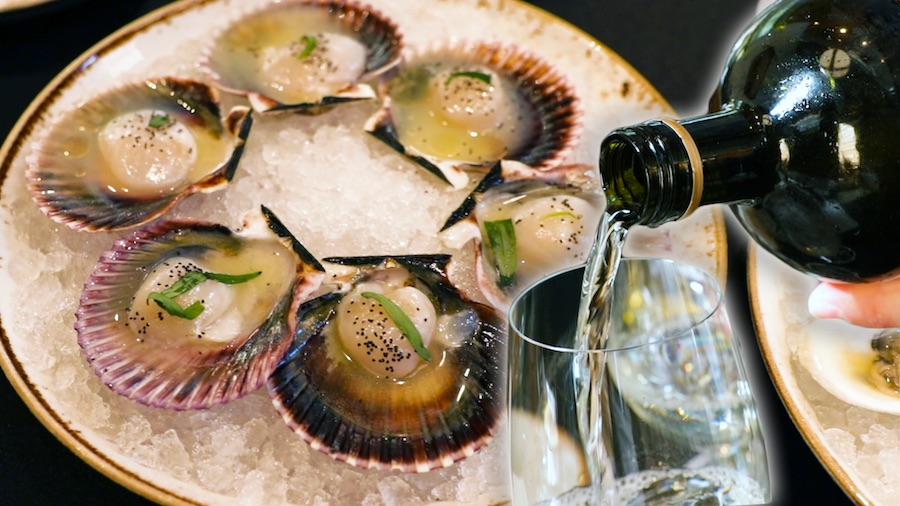
Course #6: Peruvian Bay Scallops & Horin

The sixth course featured another Daiginjo, but this time a microbrew that skipped the fruitiness and focused on a texture and mouthfeel that complimented the creamy scallops.
Course #7: Shrimp & Grits with Gochujang Sauce & Nigori

Nigori, a special type of unfiltered sake that produces a textured, thick mouthfeel, was paired with a spin off of a Southern classic to play with the gritty texture and spice of the dish.
Course #8: Grilled Octopus & Shirayuki Sake of Edo-Genroku Era “Year1702”

Made using half the amount of water as a normal brew, the Year1702 is amber-colored and naturally sweet, which provides for a phenomenal pairing with sweeter seafood dishes, like the Spanish-style octopus from the video.
Course #9: Lobster Roll & Nanbu Bijin Tokubetsu Junmai

The final course coupled a lobster roll with a simple, clean-tasting Junmai to break up the intensity of the sauce that the lobster was tossed in.
Created in partnership with JFOODO.